
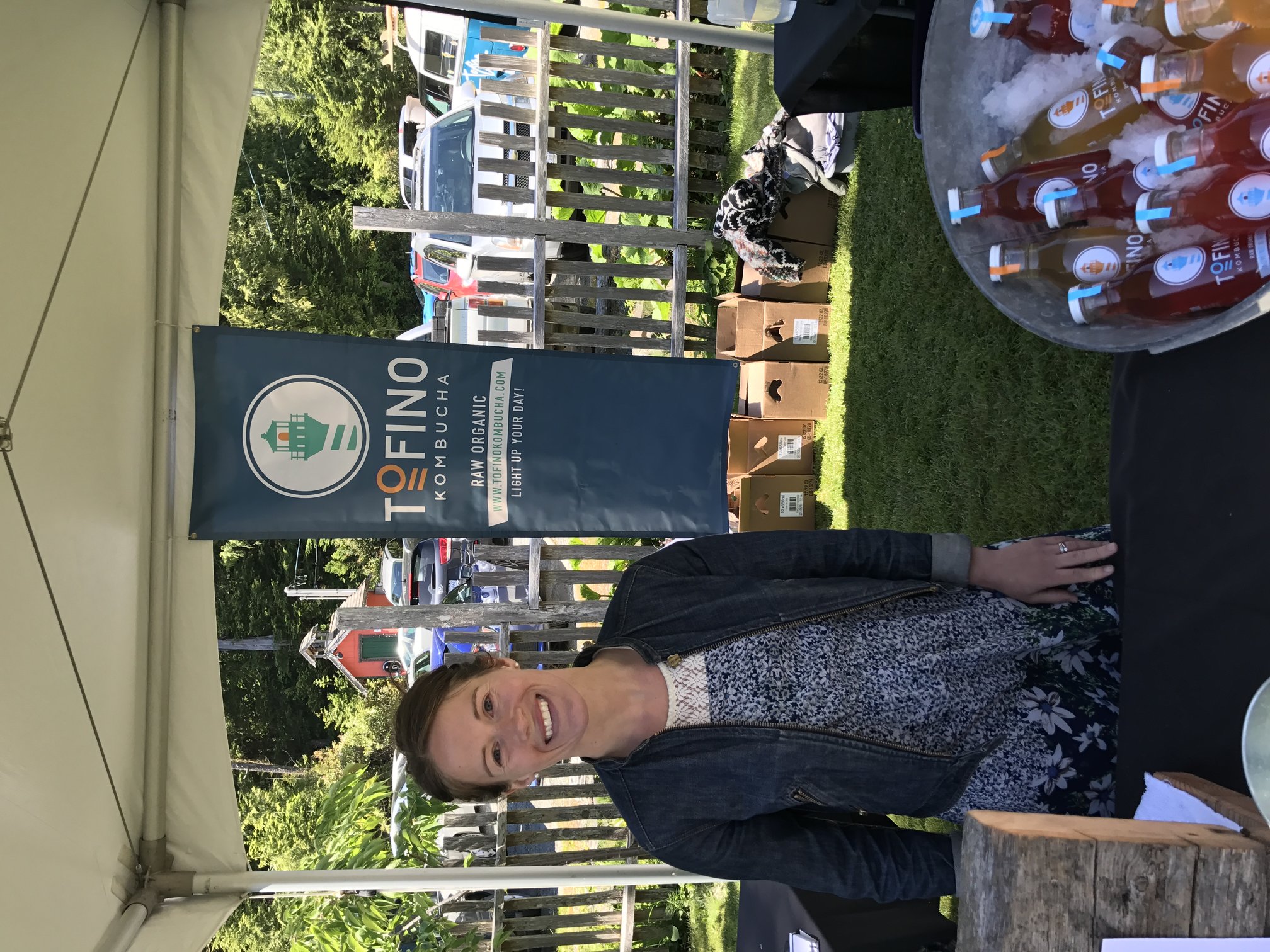
Kelsey Hendricks, Tofino Kombucha, Tofino, BC, Canada
Q: When did you first discover kombucha?
In 2013, while making a deposit at a bank, I asked the teller (who was a friend of mine) what she was drinking that day. The kombucha bottle was empty, but she let me smell the strong vinegary fumes still emitting from the bottle. Wow! I believed her when she said it was a health drink and that I should go to the store and buy a bottle. I tried it and I loved it! Soon, I had tried every brand and flavour sold in my small town, but I wanted more. Now it was time to try making it myself.
Q: Why did you start your own kombucha company?
Kombucha brewing really is an art form and when you love creating something you end up wanting to share your creation. Starting a kombucha company was a small idea that began to snowball and before you know my research into whether I should start a kombucha business turned into me ACTUALLY starting a kombucha business. It was a long process to get the business from an idea to a real thing living and growing in my basement. As exciting as it is to put a label on my bottle and see it leave for the grocery store and then see someone drinking and enjoying it, it’s even more exciting knowing that I am sharing something healthy that I love to make and hopefully it will help inspire more people to make healthier eating choices, including more fermented foods.
Q: What is your favorite flavor of kombucha?
Ferrytale Rose by Raincoast Kombucha from Powell River, BC (made with dried cherries, green rooibos and rose petals).
Q: What is your former/current other life or career?
Former career: I have a background in accounting, administration, business, hospitality, and food service – all of which have been very useful in starting a beverage company. Other life: I am a mom, a wife, a gardener, a sourdough bread maker, an okay cook, a runner, a surfer, a hiker, a camper and lover of the outdoors.
Q: What is a saying that you live by?
Always be open to learning because sometimes you don’t know what you don’t know.

 Keisha Harrison, M.S., is a PhD candidate of Fermentation Science in the Food Science & Technology Department at Oregon State University (OSU). She received a Bachelor of Arts in Cell Biology and Biochemistry from Rice University and a Master of Science in Nutrition from the University of Houston. Keisha was drawn to Kombucha research because it is a beautifully complex system to study microbial interactions. She aims to understand the links between the microbial landscape of the Kombucha SCOBY and the sensory experience. She believes to get at the heart of Kombucha, we have to get better acquainted with it first!
 Chris Curtin, Ph.D. is an Assistant Professor in the Food Science & Technology Department at Oregon State University (OSU). Prior to joining OSU in 2016 he lead the Biosciences research group at the Australian Wine Research Institute, where he was responsible for development of yeast strains and development of strategies to mitigate spoilage. The Curtin lab seeks to understand the role of yeasts and bacteria in production of fermented beverages, where often the same mix of species give us an array of possible outcomes. The Kombucha SCOBY embodies this complexity and has become a major focus of our research.



 The DNA sequencing boom changed the name of the game! With the advent of affordable and reliable genetic sequencing, high-resolution taxonomic identification became a thing of reality. First scientists used sequencing technology to characterize isolated organism as a more robust culture dependent approach. However, with next generation sequencing (NGS), we could finally for the first time identify both culturable and nonculturable organisms. With NGS technology, scientists confirmed Komagatebacter as the dominant Kombucha bacteria (Marsh, 2014; Chakravorty, 2016) revealed that lactic acid and thermophilic bacteria that are likely dependent upon Kombucha preparation and region. (See table below for comprehensive list of evaluated microorganisms) These studies finally give us an in-depth analysis of kombucha microflora.