Skip to content
  • Shop
  • Login
  • Cart
Kombucha Brewers International
  • WHY KBI
    • Mission
    • KBI Code of Ethics
    • Industry Info
    • Member Benefits
    • Join Now
  • Resources
    • Member Forum & Resource Library
    • Kombucha Code of Practice
    • Industry FAQ
    • KBI Approved Ethanol Testing Methodology
    • Best Practices
  • Our Members
    • Brewery Members
    • Supplier Members
    • Partners
  • NEWSROOM
    • Press
    • Blog
    • SYMBIOSIS Magazine
    • Achievements
  • Events
    • Kombucha Kup
    • KombuchaKon 2023
    • World Kombucha Day 2.21
    • Webinar Wednesday
  • Research & Advocacy
    • Kombucha Research Database
    • Lobbying
    • Advocacy Toolkit
    • Laraine Dave Kombucha Education & Lobbying Fund
  • For Kombucha Lovers
    • World Kombucha Day 2.21
    • Kombucha FAQ
    • Kombucha Taproom Tourism Guide
    • Consumer’s Guide to Kombucha

Category: KBI Verification Program

Webinar Series: Kombucha Standard of Identity

Kombucha Standard of Identity  DATE: 9/26/18; 1 pm PST on Zoom WHO: Hannah Crum COST: Free/Members Only WEBINAR SUMMARY Join us for a free, members-only webinar to discuss the Kombucha Standard of Identity, led by KBI President, Hannah Crum. Before the webinar, please review the Kombucha Standard of Identity (draft version), located HERE in the […]


Sunday, 16th September 2018

Kombucha Standard of Identity 
DATE: 9/26/18; 1 pm PST on Zoom
WHO: Hannah Crum
COST: Free/Members Only

WEBINAR SUMMARY

Join us for a free, members-only webinar to discuss the Kombucha Standard of Identity, led by KBI President, Hannah Crum.

Before the webinar, please review the Kombucha Standard of Identity (draft version), located HERE in the Member Forum. Since this is a members-only meeting, non-members will not be able to access the webinar or the Kombucha Standard of Identity.

WEBINAR TAKEAWAYS

– Definition of Kombucha

– Pasteurization

– Label Declaration

– And much more!


ABOUT THE WEBINAR INSTRUCTOR

Hannah Crum has taught Kombucha making classes to all size groups, from individuals to workshops of 100+, all over the country for over a decade, spreading the message of Kombucha and its bacterial benefits far and wide through a variety of venues including festivals, health conferences, podcasts, interviews, articles and more. Her how-to videos have piled up +100,000’s of views and Kombucha Kamp was featured on “What’s Brewing?” hosted by Jody Rudman on the Veria Network.

In addition to teaching, Hannah installs large-scale Kombucha set-ups and is the Master Brewer for numerous restaurants and shops in the Los Angeles area, as well as consult for many Kombucha brands from those just starting out to established breweries looking to scale up.  In 2014, as an extension of their desire to “change the world, one gut at a time” while growing the Kombucha industry, Hannah and her partner, Alex, co-founded Kombucha Brewers International – a non-profit trade association dedicated to promoting and protecting commercial Kombucha around the world.

TTB Meeting Recap: February 2, 2016

On February 2nd, 2016, Hannah Crum, KBI President, met with several members of the TTB (Alcohol Tax and Trade Bureau) to discuss the trace amounts of ethanol naturally produced by the kombucha fermentation process and what steps the industry is taking to ensure companies remain in compliance of the current legal threshold for taxation of […]


Tuesday, 9th February 2016

On February 2nd, 2016, Hannah Crum, KBI President, met with several members of the TTB (Alcohol Tax and Trade Bureau) to discuss the trace amounts of ethanol naturally produced by the kombucha fermentation process and what steps the industry is taking to ensure companies remain in compliance of the current legal threshold for taxation of .5% ABV (alcohol by volume). Talking points included discussing the agency’s desire for the industry to self-regulate, the ethanol testing standard being developed with the AOAC, and an informative discussion on the numerous techniques utilized by the industry to reduce alcohol in addition to refrigeration.

The hour-long meeting was yet another step in establishing a closer relationship with the TTB in light of the letters that were sent to a handful of KBI members in 2015. Since kombucha is not intended as an alcoholic product, the TTB stated that it has no desire to regulate kombucha and prefers that the industry do so on its own. KBI agreed that self-regulation, just as in every other industry, would be the best way to reduce potential mislabeling and product quality concerns. To that end, KBI has already developed a set of Best Practices for all kombucha brewers that relate not only to alcohol testing but also to sanitary and business practices.

Armen-Mirzoian-Cathy-Halverson-of-TTB-Daina-Trout-Hannah-Crum

While the TTB is a partner in the AOAC process, it also reiterated that its participation in the consensus-based standards development process did not guarantee adoption of the new testing standard once fully vetted. The TTB maintained that its current testing methods (distillation and densitometry), which have been in use for over 100 years and are used to test the ethanol content of all kinds of products including foods, additives and other ingredients, are sufficient for detecting even low levels of ethanol. However, the TTB representatives also acknowledged that any other testing method may also be utilized provided it is validated. KBI has submitted the current approved testing methodology with validation to the TTB.

TTB staff were glad to learn of the several techniques already utilized by the industry for controlling ethanol production in kombucha. These include filtration, dilution, culture selection based on organisms, and aeration in addition to insisting on cold storage throughout the supply chain handling. Moreover, kombucha often contains similar amounts of ethanol to juice, sodas, and energy drinks, especially in light of the fact that the flavorings for these products are often in an alcohol-based carrier.


IMG_3027

Overall, the meeting was a huge success and confirmed that both the TTB and the kombucha industry have the same goals – safe, compliant products that adhere to Best Practices. After the meeting, several TTB staff offered assistance to KBI and the kombucha industry as we continue to develop appropriate controls and protocols while determining what methods of testing will provide accurate and repeatable results. With the measures KBI is taking both with AOAC and the Verification program, we are on the path of self-regulation.

KBI Presentation to AOAC SPSFAM Panel – Working Group to develop new testing method for ethanol in kombucha

On Sunday, September 27th, KBI president Hannah Crum and and Heath-Ade CEO Daina Trout, head of LGO committee (Special Projects Team) presented to the Stakeholder Panel on Strategic Food Analytical Methods (SPSFAM) at the annual conference of the Association of Official Analytical Chemists (AOAC) to establish a new Working Group with the aim of developing a […]


Sunday, 25th October 2015

On Sunday, September 27th, KBI president Hannah Crum and and Heath-Ade CEO Daina Trout, head of LGO committee (Special Projects Team) presented to the Stakeholder Panel on Strategic Food Analytical Methods (SPSFAM) at the annual conference of the Association of Official Analytical Chemists (AOAC) to establish a new Working Group with the aim of developing a new testing standard for the low levels of ethanol in kombucha. Experts across various industries specializing in manufacturing, food chemistry, and laboratories were present as well as representatives from government organizations like the TTB.    

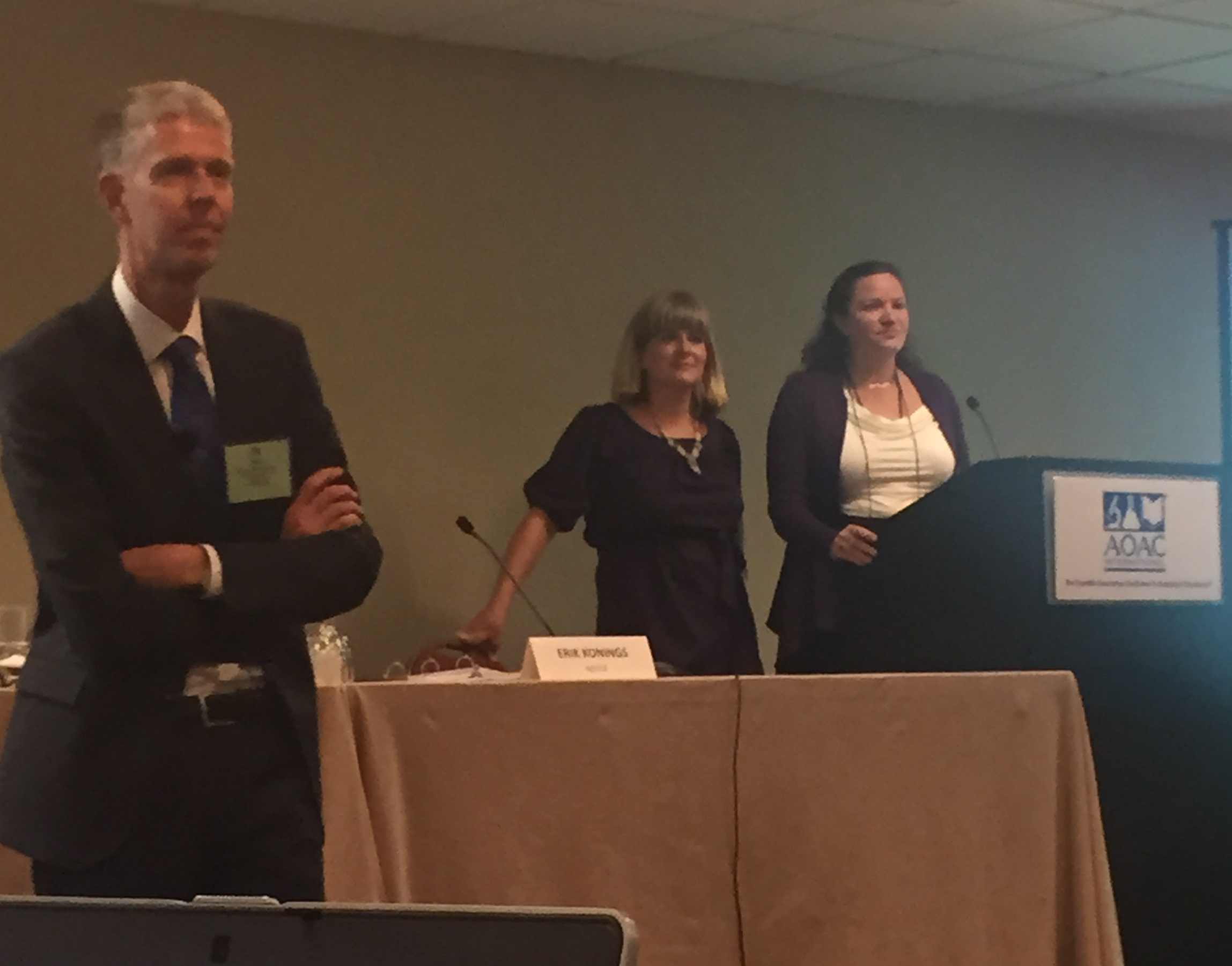
erik konings nestle daina trout healthade hannah crum kombucha kamp 9.27.15
Erik Konings of Nestle presiding over the SPSFAM with presenters Daina Trout of Health-Ade & Hannah Crum of KBI

Hannah and Daina shared with those in attendance the explosive growth in the kombucha industry while enumerating the difficulties with the testing methods in use by regulators in the US today. The message was clear: currently, an accurate, standard method of testing that takes into consideration the complexities of kombucha such as the strands of living culture, yeast bodies, organic acids, low pH and other factors simply does not exist. The Q & A was lively with questions, support and enthusiasm from the audience for this fascinating scientific problem and very much echoed that current methodologies need to be revised.  

The stakeholder panel eagerly took up the process of formulating a Fitness for Purpose (FOP) statement. The FOP is ultimately the parameters that the Working Group will establish before sending out a request for methods to the international membership. 

Fitness for Purpose statement: Methods need to accurately and precisely measure the ethanol concentrations to comply with alcohol and non-alcohol declarations in Kombucha in-process and finished products.  

The Working Group will now proceed under co-chairs Hannah Crum and Sam Labonia of Cornerstone Labs. The goal is to hone in on the issues that will be necessary to take into consideration for determining accurate testing methods. KBI anticipates presenting the Standard Method Performance Requirements (SMPR®) to the SPSFAM Panel at the AOAC Midyear Meeting in March 2016 in Maryland. Since AOAC standards are in use by governments around the world, including the US, the TTB (Tax & Trade Bureau) has also been invited to participate in the process and are members of the Stakeholder Panel that will vote to determine the ultimate methodology that is selected.

Armen Mirzoian Cathy Halverson of TTB Daina Trout Hannah Crum
Armen Mirzoian, Chief Science Officer, and Cathy Halverson, Head of Alcohol Testing Lab, of the TTB attend the AOAC Stakeholder Panel and continue to participate in the Working Group spearheaded by KBI, Health-Ade and other KBI members

The reaction from not only the stakeholders, but the general AOAC attendees was overwhelmingly positive and enthusiastic about the direction of this research. Not only was the presentation very well received, the questions asked after were informed and thought-provoking.  Overall, KBI is thrilled to get the opportunity to work with the AOAC to find a method of testing ethanol in kombucha that produces accurate, consistent, repeatable results.  “The AOAC is pleased to be working with the kombucha industry, regulatory bodies, and other stakeholders to develop such a standard,” stated E. James Bradford, Ph.D., Executive Director of AOAC International.

The working group meets regularly (biweekly) to refine definitions and identify criteria for the SMPR® 

Get the latest updates on the Working Group in the Alcohol – Testing & Control Group on the KBI Member Forum.

Current Testing Methods for Kombucha

Kombucha is a complex, living product with an enormous range of styles and flavors that delight the senses and enliven the body. Mixed with juice, spices or brewed with other beverages; it is most often consumed raw but can also be filtered, force carbonated or in some cases pasteurized; and it can be fermented with […]


Wednesday, 14th October 2015

Kombucha is a complex, living product with an enormous range of styles and flavors that delight the senses and enliven the body. Mixed with juice, spices or brewed with other beverages; it is most often consumed raw but can also be filtered, force carbonated or in some cases pasteurized; and it can be fermented with a variety of substrates yielding new and exotic combinations. This amazing diversity of expression is part of the mystique of kombucha but also presents difficulty when testing for ethanol due to its inherent biodiversity and complexity, as well as the wide spectrum of serving possibilities.

Kombucha companies currently rely on individual labs to test for ethanol. The KBI Special Projects Team (sub-committee of LGO) contacted over a dozen labs with experience working with kombucha and discovered that each lab has its own method for testing for ethanol. Three main methods are being utilized for testing ethanol in kombucha – alcolyzer (refraction), densitometry and gas chromatography. Moreover, each lab will apply their own tweaks and adjustments to the process in order to account for kombucha’s unique characteristics. The inconsistency in methodology is concerning because kombucha has so many quirks that need to be accounted for and numerous decisions in the testing process can have a significant effect on the final result. With so many changing the methods ever so slightly, it is little wonder that consistent results are simply not achievable.

Oftentimes, the sample is simply run through a beer alcolyzer system designed to effortlessly detect the much higher, and therefore easier to measure, levels of ethanol. Kombucha, being far more complex than beer, contains organic acids, fermented sugars, and live culture strands that are simply not present in most commercial beers. Moreover, the unique kombucha culture is a symbiosis and the bacteria consume the ethanol created by the yeast into organic acids that may have a similar density to ethanol thereby creating false positives.

Just a handful of labs are currently using more sophisticated techniques, like headspace gas chromatography to suss out the nuances. This method shows a lot of promise as it opts to use far lower detection limits than is recommended in the AOAC method for testing beer, consistent with the lower levels of ethanol observed in kombucha. Another difference in sample handling is to not centrifuge it to avoid adulterating the analyte.

Still others utilize AOAC 983.13 method for testing wine that relies on centrifuging the kombucha sample to remove the high levels of sediment present in kombucha and then later factors in the removed sediment into the final mass percentage.  This method shows similar results to the modified 984.14 method, and shows promise when adjusted for kombucha’s low detection levels. What is abundantly clear, however,  is that there is no consensus available for the appropriate method to use when testing kombucha.

In one lab, the same bottle of kombucha was tested using the beer alcolyzer and a modified AOAC 984.14 method for testing beer. The beer alcolyzer system claimed that the kombucha contained levels of ethanol higher than 0.5%, the level above which a beverage must be marketed as alcoholic. When analyzed using the modified AOAC method, a gas chromatography method, the kombucha was tested to be well under 0.5% ethanol. Because the limit for alcohol content in non-alcoholic kombucha is so low at 0.5%, it is imperative that the testing is done accurately and precisely. When an unmarked bottle of Bud Light was tested, both the beer alcolyzer system and the gas chromatography method were highly precise, possibly because its higher alcohol content is easier to detect with higher detection limits.

The lack of consistency is evident even at the same lab. The same samples were sent with different labels to a lab and the test results for the exact same samples had a variance of +/- 1% ABV – that’s more than double the legal limit! So, how do we all get on the same page and find an accurate, repeatable, consistent test for ethanol in kombucha? Collaboration, of course! We are symbiotic after all.

The kombucha industry is reaching out to collaborate with the most educated body of scientists to establish a new testing standard for ethanol in kombucha. By partnering with AOAC, KBI participates in an ethical, scientific process for creating testing methods. Moreover, the TTB, FDA and other government, non-profit, academic and others will work together and decide through consensus on the appropriate method for accurate, consistent and repeatable results. The lack of definitive research in this field has frustrated kombucha brewers who are taking measures to brew compliant products and regulatory agencies. Working with industry experts, KBI hopes to reach a universal truth for testing kombucha to better serve and inform consumers.

  KBI Logo Square

HACCP Plan – What is it and why its important

What is a HACCP Plan? A Hazard Analysis and Critical Control Points or HACCP Plan is a systematic approach to the identification, evaluation, and control of food safety hazards (biological, chemical, and physical) throughout the production process to prevent the risk of foodborne illness or other safety concerns. HACCP is based on the following seven […]


Monday, 31st August 2015

What is a HACCP Plan?

A Hazard Analysis and Critical Control Points or HACCP Plan is a systematic approach to the identification, evaluation, and control of food safety hazards (biological, chemical, and physical) throughout the production process to prevent the risk of foodborne illness or other safety concerns. HACCP is based on the following seven key activities:

  • Conduct a hazard analysis
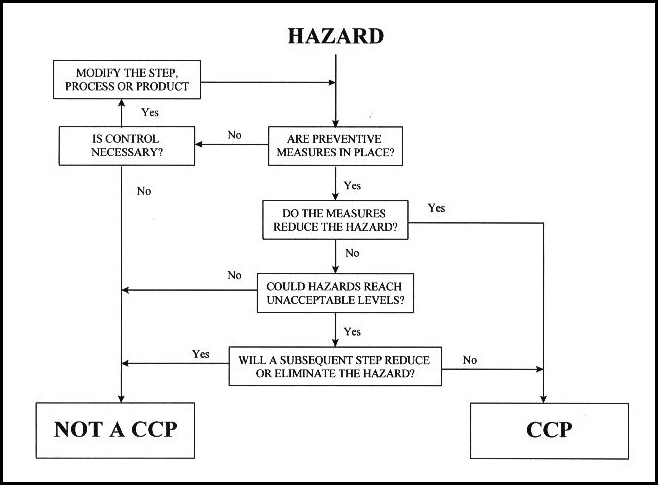
  • Determine critical control points (CCP)
  • Establish critical limits
  • Establish a monitoring system
  • Establish a procedure for corrective action for use when monitoring a CCP indicates a deviation from an established critical limit
  • Establish procedures for verification to confirm the effectiveness of the HACCP Plan
  • Establish documentation concerning all procedures and records appropriate to these activities and their applications

haccp_hazard

Which industries require it?

HACCP should be used in conjunction with other food protection programs and is mandatory for meat & poultry (USDA), seafood (FDA), and juice (FDA), and voluntary for all other food and beverage industries. Now that FSMA is being enforced for every size business, KBI highly recommends that all commercial Kombucha brewers have a HACCP Plan in place.

Why does KBI recommend it?

KBI’s newly established Best Practices list having an HACCP Plan in place as an important action item for commercial Kombucha brewers. These Best Practices have been voted into place by KBI’s own member organizations, which represent the majority views of some of the world’s leading Kombucha producers.

Furthermore, products produced by the Kombucha industry are often raw (unpasteurized) and are consumed by people around the world primarily for their health benefits.  Therefore, it is in the best interest of public health to take as many precautionary measures as possible to produce healthful, safe beverages which meet established food safety standards. As this rapidly growing industry continues to expand, we feel that it is important to operate our brewing companies with integrity, safety, and quality in mind, while also keeping in mind the extra layer of protection a HACCP Plan can offer the public.

In addition, when local, state, and/or federal inspections occur, an established HACCP Plan highlights the company’s efforts to produce safe products and demonstrates/documents all of the key elements required.  HACCP Plans also make it much easier to communicate with inspectors who may not be familiar with Kombucha products and/or the Kombucha industry as a whole.

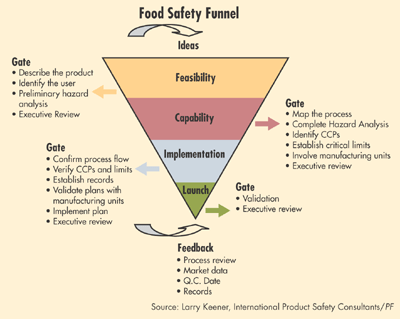
haccp funnel

How do I develop an HACCP Plan?

Developing an HACCP Plan can be very time consuming and rigorous . Fortunately, KBI has developed a hazard analysis template, which is available to brewery members at a discounted price (it is also available to non-members). 

Not a KBI member yet?

Whether you’re just starting out or already have an established Kombucha company, we invite you to join KBI to take advantage of our many member’s only resources and benefits, including the HACCP Plan template mentioned above. To learn more about our member benefits, to view our membership requirements or to join KBI, please click here.


Updated: May 2022

About Us

    • KBI Board
    • KBI Team
    • Committees & Volunteers
    • Bylaws
    • KBI Jobs

Advertising

    • Overview
    • Print
    • Digital
    • Events
    • Sponsored Content

Recent Posts

  • President's Tour Kombucha Chat | Circle Bev
  • Happy International Women's Day to KBI's Fempreneurs
  • Meet Our Members –Fermentation Farm (CA)
  • Meet Our Members – Pigeon Cove Ferments (MA)
  • Meet Our Members – Tonica Kombucha (CAN)

Contact Us

8950 W Olympic Blvd, Ste 494,
Beverly Hills, CA 90211

Facebook Instagram Twitter Youtube Email

Subscribe to our Newsletter

Subscribe

Kombucha Brewers International © 2025